
The lost Parker films
The two film adaptations of Westlake's master thief nobody talks about

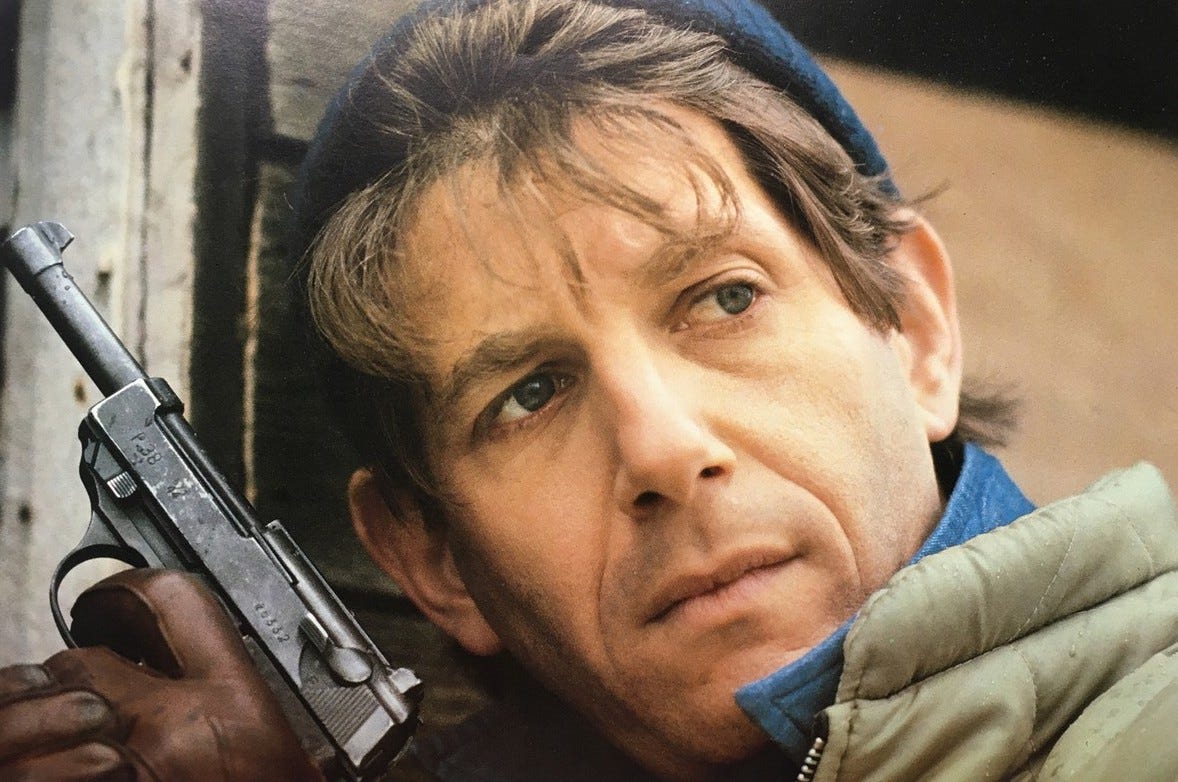
Regular readers of this newsletter will be familiar with how much I rate the professional thief character of Parker, created by Donald westlake. Parker appeared in 24 novels, all written under the pseudonym Richard Stark, broken into two main eras, a run between 1962 and 1974, and a later revival of the series between 1997 and 2008.
There has never really been a prolonged period when I have not been thinking about the series. The books are desert island reads for me. And my last two crime novels, Gunshine State (2016) and Orphan Road (2023) - both sadly now out of print - were very deliberate Australian homages to the Parker series. I am also a fan of the film adaptations. Well, most of them.
Nine films based on the Parker novels have been made. But, of these, there are two that nobody ever really seems to talk about. Which is a shame because, IMHO, they are actually two of the better adaptations. The first is Mise à Sac (which translates as ‘Put in a Bag’ but I have also seen English language promotional material under the titles Pillaged and Midnight Raid). This is a 1967 French adaptation of the fifth Parker novel, The Score, published in 1964, and which has also appeared under the title, Killstown. The second is Slayground (1983), based on the 1971 book of the same name, the 14th instalment in the first cycle of Westlake’s Parker series.
The Score involves Parker being recruited by a man named Edgars to rob a small mining town in North Dakota called Copper Canyon. There is one road in and out of town and Edgar’s wants Parker to head up a group of men who will go in, capture the town’s police and telephone exchange, then systematically loot its banks, the mining company’s payroll, and its jewellery store. Despite being hinky on Edgars, Parker agrees to do the job because the reward is worth the risk. The story details the process of putting the team and planning and executing the job. It is a complex operation with a lot of moving parts. Despite this, everything seems to go to plan until Edgar’s reveals his hand in a most spectacular way as someone with a massive grudge against the town. He doesn’t just want to rob the inhabitants; he literally wants to burn the place to the ground.
Mise à Sac opens with the Parker character, called Georges in the film (Michel Constantin), arriving in France’s third largest city, Lyon. He cuts a fairly determined figure, tall, silent, granite faced, dressed in a black suit he hardly ever takes off. His first encounter with the Edgars character (Daniel Ivernel) gets off to a bad start and Georges almost pulls the plug on the entire job because Edgars is stupid enough to have him followed to the meet up. But Edgars, who comes across as a harmless petti-bourgeois businessman, overcomes Georges doubts by admitting up front that he has zero criminal experience and allowing the professional thief to take total command of the job. Much like in the book, this involves putting together a crew to rob a small factory town about a hundred kilometres away, called Servage, surrounded by mountains, with one highway in and one way in or out.
The second quarter of the film involves Georges putting together the twelve-man criminal team to hit the town. They go in at night with military precision, split into teams, staying in contact via walkie talkies, taking over the police station and the telephone exchange. They proceed to knock off the lot, the banks, factory payroll, post office, and the jewellery store.
The film takes its time showing the teams undertaking their various missions, including some wonderfully filmed simultaneous safe cracking. Some people may find this a bit slow, but quite apart from a great bit of logistics porn, I loved the painstaking detail with which the men undertake their various missions. Meanwhile, one of the gang, Maurice (Franco Interlenghi) – based, for those that are familiar with the source novel, on the Alan Grofield character – has the job of sitting in the telephone exchange and making sure one of the female operators cooperates with the gang by monitoring phone traffic in and out of Servage.
Although the job seems to be going like clockwork, complications ensure when Edgars breaks away from the group to go and case out the town’s wealthiest house. It becomes apparent when he sets it on fire that he has a grudge to settle to with its occupants. This results in him being shot by the owner, which blows the whole job and brings the police to the town in force.
The gang has to abandon their tasks half-way, get out of Servage and break into small groups to evade police capture. Some get caught. Georges and one other man manage to make to make it onto a bus departing from a nearby town and, as it pulls away, they watch several members of the gang being taken into police custody in a nearby field. The manhunt is a one of the most fascinating sequences in the film, partly because it is so low key and there is this wonderful philosophical sense on the part of the gang members that getting pursued and potentially arrested by the cops is just part of the life. This hard boiled no fuss tone infuses the entire film. There is nothing spectacular about what these criminals do, their trade just happens to be stealing and they approach it in the same no nonsense way that any professional approaches his or her profession. It reminded me of other films about blue collar criminals that appeared in the late 1960s and early 1970s, like The Friends of Eddie Coyle (1973) and The Nickel Ride (1974).
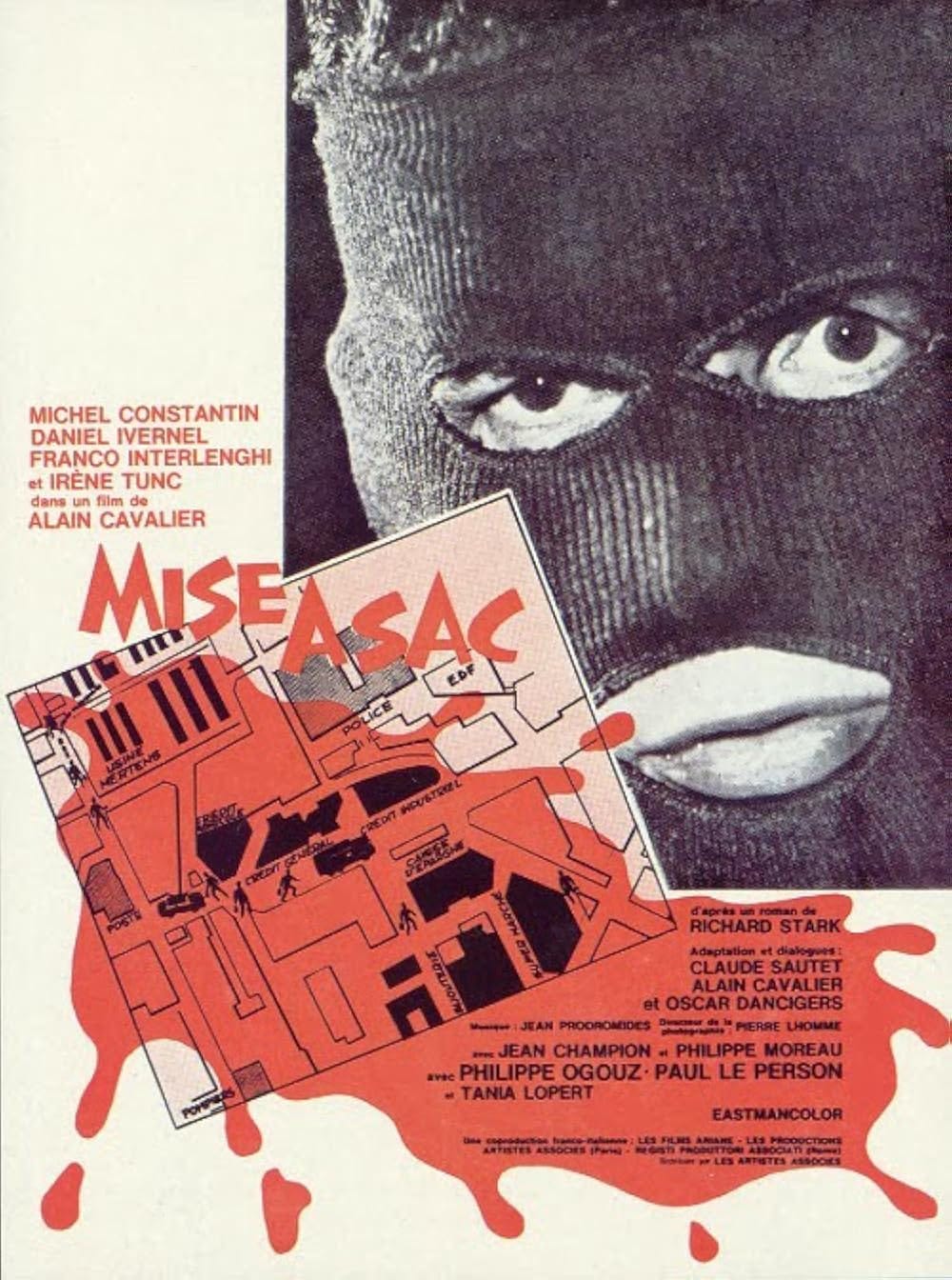
But potentially the most fascinating aspect of Mise à Sac is how it was part of a significant eco-system of French crime cinema in the 1960s and 1970s, which only had limited crossover with audiences in Australia or America and, hence, that we are only now starting to get across.
Constantin, who makes a great Parker, had a lengthy acting career, 64 films spanning the late 1950s to the late 1980s, only a smattering of which I have seen. The marvellous prison break film, Le Trou (1960), Sergio Sollima’s Violent City (1970), and another Charles Bronson vehicle, Cold Sweat, directed by Terence Young in 1970. The rest of his output, including what appear to include some great crime and espionage films, I know zero about. The film was directed by Alain Cavalier, who has a number of pictures to his name which, likewise I do not know anything about. Cavalier co-wrote the adapted screenplay Claude Sautet, who I am a little more familiar with as the writer of the great French gangster film Classe Tous Risques (1960) and the stunning body horror, Eyes Without a Face (1960).
I am going to put my cards on the table up front and say that while Slayground is among my least favourite of the first tranche of Parker novels, this British film version is one of the most interesting adaptations.
The novel depicts what happens after Parker and his criminal associates are forced to to hire a second-rate wheelman for an armoured car heist. The job goes wrong and Parker narrowly escapes the law with $74,000 from the robbery. He stumbles across an amusement park called Fun Island, closed for the winter, and figures it is as good a place as any to hide until the heat from the job dies down. A major hitch arises when a couple of corrupt cops make Parker entering the park. They put two and two together in terms of linking him the armoured car job and inform the local mob, who surround the park and proceed to hunt Parker down for the money.
The film begins on the outskirts of New York with a guy called Laufman (David Hayward) picking up a young, attractive, female hitchhiker who he thinks is a hooker. He drives her somewhere remote with the intention of having sex and she kills and robs him. This is a major problem for the film’s Parker character, Stone (Peter Coyote), and his partner, Joey (Bill Luhrs). Now without a driver for the armoured car robbery they have been planning, they are forced to engage a young hothead called Lonzini (Ned Eisenberg) as their wheelman. The job goes off without a hitch but as he escapes, Lonzini runs a red light and causes a crash in which a young girl is killed.
Stone is left traumatised by the girl’s death. “I’ve never killed anyone,” he says. Unbeknownst to Stone, the girl’s father, Danard, is a shady businessman who hires a mysterious hitman to kill those responsible for his daughter’s death. We never find out the hitman’s identity. His only identifying features are his silhouette, his leather gloved hands, and his creepy slightly sibilant voice as he taunts his victims.
The hitman proceeds to track down and murder the heist gang, first Lonzini, then Joey. He nearly kills Stone twice, the second time putting him in the hospital. A criminal contact breaks Stone out of hospital and gets him a false passport. After sending his wife to hide in Mexico, Stone flees to London to look up an old criminal associate who owes him a favour, Terry (Mel Smith, who is probably most familiar from his time as a cast member on the subversive 1970s/80s British comedy show, Not the Nine O’clock News).
In London, Stone goes to a doctor who tells him he needs an expensive operation, otherwise the injuries he sustained from the second attempt on his life will leave him crippled. Stone finally tracks down Terry, working as a mechanic in a seaside town amusement park called Pleasure Beach, owned by his girlfriend, Madge, played by Billie Whitelaw. Madge is in serious financial strife and being pressured to sell the park to a vicious gangster called Venner. Stone needs money for his operation. Terry wants money so he can keep the park open. The two of them decide to team up again and rob Venner’s casino as a way of solving both their problems. All the while, of course, the hitman has been pursuing Stone and tracked him down to the seaside town.
Some online critics have accused Slayground of almost being two films that really don’t talk to each other, the first part of the story set in the US and the second part of the film, set in the UK. I don’t agree. The transition from the American to the British setting is a little clumsy and the two halves look very different – no doubt the result of the fact that each had different cinematographers. The first part evinces a more hard boiled sensibility characteristic of a lot of American films from that time. The second has a seedier, more down at heel feel that I very much associate with a lot of 1970s/80s British cinema (the amusement park scenes were shot at a place called Pleasureland at Southport – UK readers please tell me that it still exists). But overall, the story works, and I enjoyed how two parts interacted with each other.
I am not really familiar with Coyote’s work, but he depicts Stone as a more hangdog type character. Everything he touches turns to shit. The film is relentlessly dark, something else I enjoyed, with a real noir sense of problems piling up on Stone, leaving him cornered and with very few options. As Terry says to him at one stage: “You’re fucking crazy, you know that? Do you? You’ve lived half your life and where are you? Five thousand miles from home, in a bankrupt seaside town, on a sly passport, talking shit to a dead man.”
Whitelaw, who doesn’t have a huge part, is the most famous face (her career stretched back to the 1950s and included the creepy housekeeper, Mrs Baylock in The Omen in 1977, and the ruthless mother in the very underrated 1990 biopic, The Krays). apart from her, Coyote and Smith, there’s no one who really stands out as a name. But that kind of worked for me, too.
Another major thing in Slayground’s favour is the way in its noir styling is mixed with other cinematic influences, the eighties psychological thriller, and an almost giallo sensibility. The latter manifests in the unknown assassin, a shadowy black gloved psychopath who would have been right at home in Mario Bava’s Blood and Black Lace (1964) or Dario Argento’s Deep Red (1975). He targets everyone connected to Stone, undertaking a string of grisly murders – tarring and feathering one man, drowning another in a fish tank – to carry out the contract. This culminates in a well executed shootout with Stone in the otherwise empty amusement park.
Slayground was directed by Terry Bedford with a script by Trevor Preston. Bedford didn’t do very much but Preston had form writing for a host of hard boiled British television shows in the 1970s, including Callan, Special Branch, and The Sweeney, and he did the script for the strange 2003 Mike Hodges film, I’ll Sleep When I’m Dead.
Dark of the Sun: Projection Booth podcast episode #802
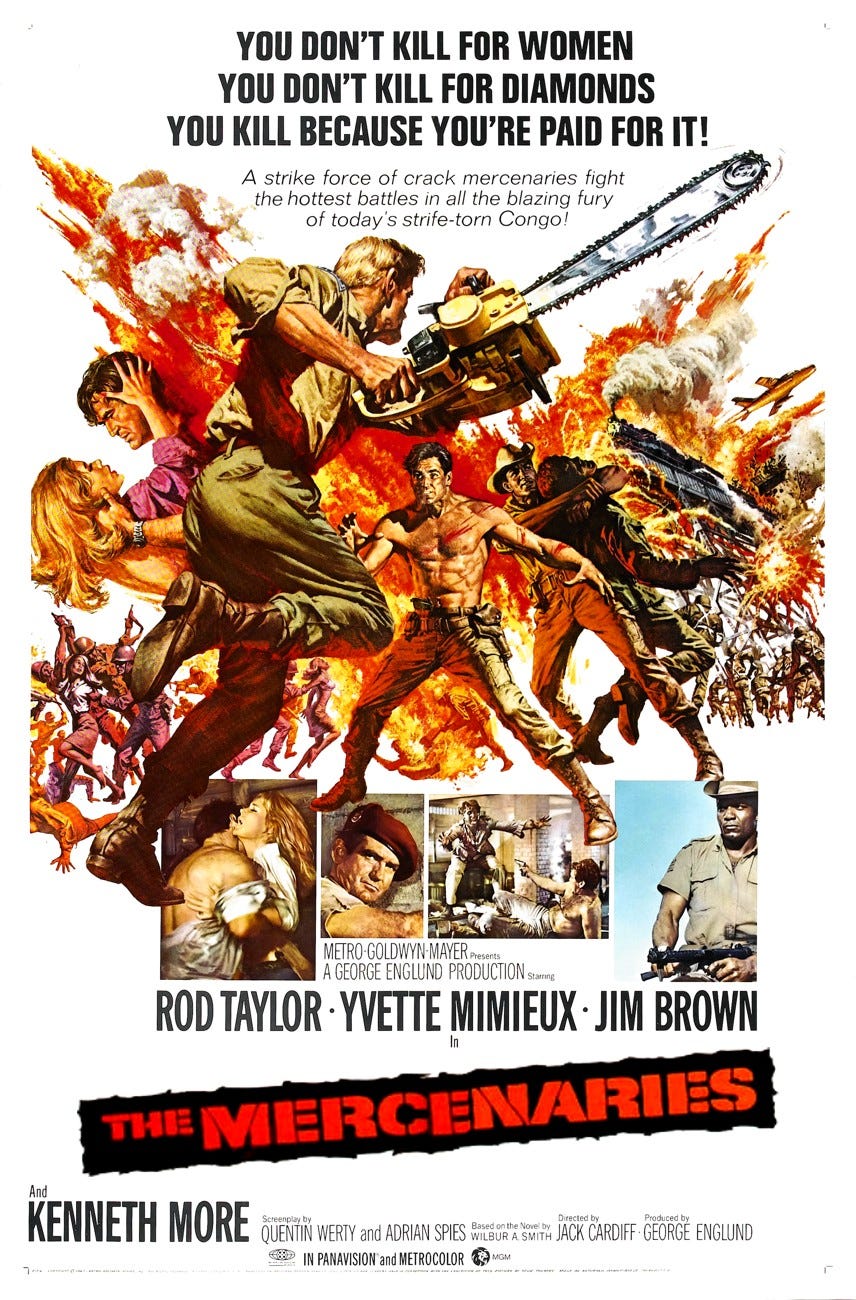
Chainsaws, trains, diamonds and geopolitics collide when I joined Jedidiah Ayres and Mike White to co-host episode 802 of The Projection Booth podcast, a deep dive into Jack Cardiff’s 1968 classic, Dark of the Sun. Goodness for your ears.
Until next time.
Thanks for this post! The Score is one of my favorite crime novels and I had no idea it had been adapted. I just completed a series of reviews of heist movies on Substack, including a couple of French classics.
Great post! I recently wrote a short story that's an ode to Parker and the character's various iterations, for an anthology coming out next year. Always enjoy conversations around the lesser-known films.