
Down with the guilty pleasure: Appreciating Jack Cardiff’s Dark of the Sun

The concept of a guilty pleasure is up there with the word problematic as my most despised terms when it comes to cinema. One film that is regularly described as a guilty pleasure is Dark of the Sun (1968), or as it was released in some territories, The Mercenaries, directed by legendary British cinematographer, Jack Cardiff, and adapted from a 1965 adventure novel by the Rhodesian-born writer, Wilbur Smith.
I was recently reminded just how much I love this film when I guest hosted on an upcoming podcast episode about it. Dark of the Sun is one of those rare movies where everything comes together almost seamlessly. It has a great cast, many of them doing what is arguably their best work, and a wonderfully haunting score by Jacques Loussier. Jamaica works as a good stand in for the Congo, where the story is set but which the production was unable to shoot in due to the political instability there. And, it looks great, by turns lush and grimly sweaty. This is no surprise, given it was shot by Edward Scaife, no doubt with assistance from Cardiff, one of Great Britain’s most accomplished postwar cinematographers. It’s a heist film, and a men on a mission film. It contains some great logistics porn at the same time as being a superb action film with a lean, propulsive narrative.
But it is two other aspects of Dark of the Sun are particularly worth mentioning. This film goes to places that so many other films are simply afraid to go. Material that a lot of films wouldn’t dare to include, or, if they did, they would make the centrepiece or denouement of the entire story, take place often and without restraint. And it does this with a radical political sensibility, interrogating everything from the ethics of being a mercenary to the dynamics of global imperialism.
The movie stars Sydney-born Rod Taylor as Captain Bruce Curry, a tough, cynical mercenary. Curry is hired by President Ubi (Calvin Lockhart), the urbane but menacing head of the strife torn Congo, and his fat, sweaty Belgium mining company overlord, to lead a detachment of local soldiers on a train – an actual working steam locomotive – to a remote township called Port Reprieve and rescue the Europeans who have been trapped in the midst of an uprising by a group known as the Simbas. Curry is under no illusions that the real mission is to retrieve 50 million dollars in diamonds sitting in the township’s time-locked vault. Ubi needs the diamonds to buy weapons to fight the rebels. “I’m running out of time Captain,” Ubi tells Curry. “They’ve started to pull the plug on me, those bankers in Switzerland, Brussels and France.”
Curry’s friend and partner on the mission is Ruffo, played by Jim Brown, one of my favourite sixties action stars and fresh from his role in Robert Aldrich’s The Dirty Dozen. Also, along for the ride is a washed up alcoholic doctor (Kenneth Moore), and a brutal Nazi mercenary, Henlein, prolific German genre film actor Peter Carsten. Yvette Mimieux, in her second pairing with Taylor after The Time Machine in 1960, is a young widow who joins them mid-mission for protection from the rampaging Simbas.
The film’s centrepiece is a nail biting sequence in which Curry and his mercenaries, having packed the frightened expatriates onto the train for the return journey, wait for the time delay safe holding the diamonds to open. They get to the diamonds just as the Simbas attack. But as the train pulls away from the township, a well-placed Simba mortar shell blows up a coupling, separating the carriage with the civilians and diamonds from the rest of the train. Curry and his men watch in horror as the carriage moves slowly backwards down the hill into the hands of the waiting Simbas. It’s very bad news for the Europeans on the carriage. It also means Curry and Ruffo must find some way of getting back into the now rebel held township to recover the diamonds.
Dark of the Sun didn’t do particularly well upon its release and remained pretty much unknown until Quentin Tarantino championed it, giving it cult status, and Warner Archive released a manufacture on demand disk. I first clocked the film with my parents in the late seventies/early eighties (I can’t remember exactly) on the Sunday night movie of the week on free to air TV. It’s hard to conceptualise now, but the Sunday night movie was a big deal back then. Anyway, it blew my young head off and I’ve watched it many times since, first on an old second hand VHS copy I owned, then on a copied DVD version bought on the Internet, and finally on the Warner Archive DVD.
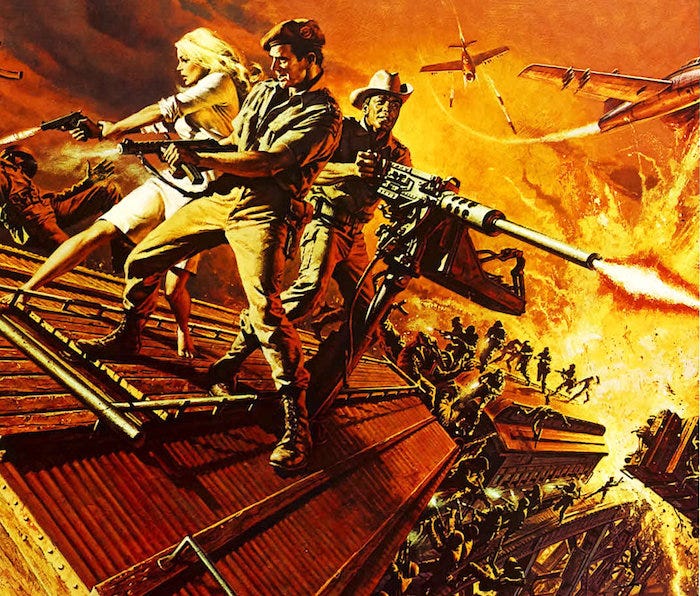
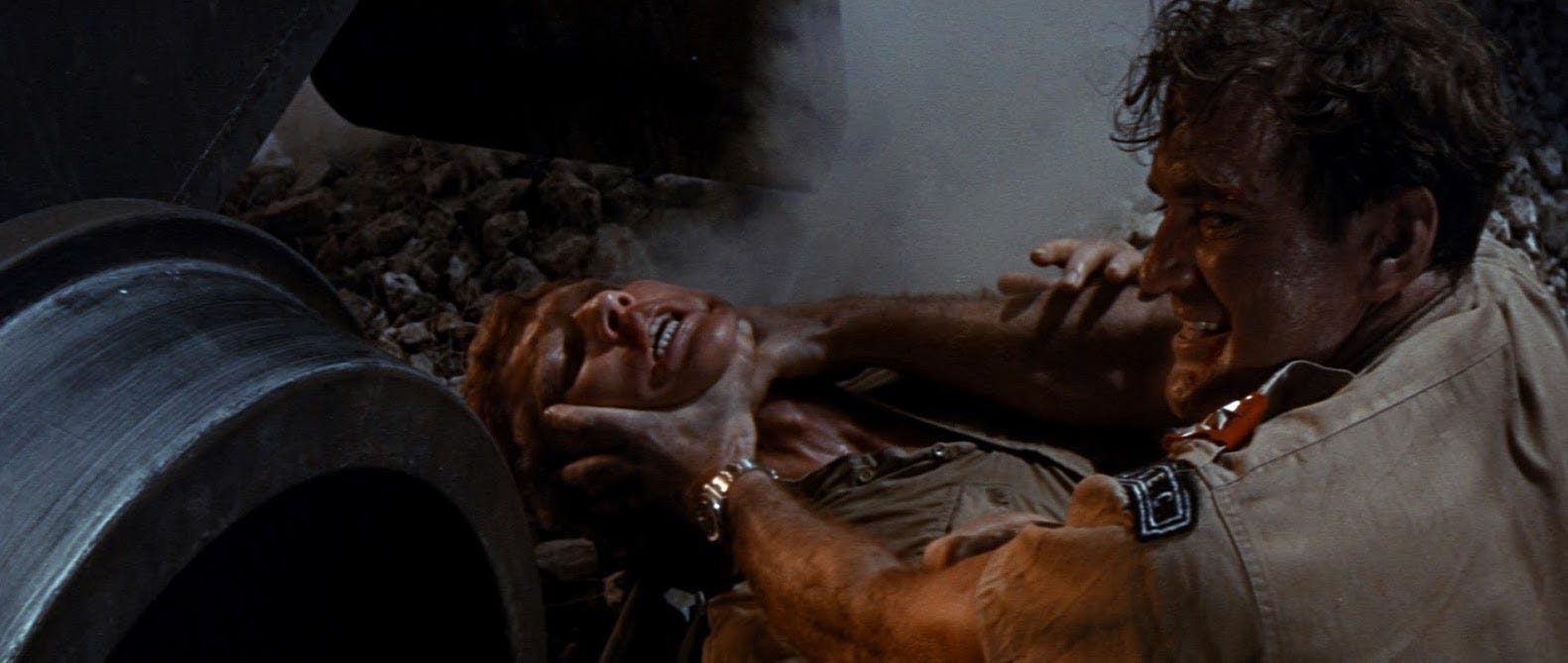
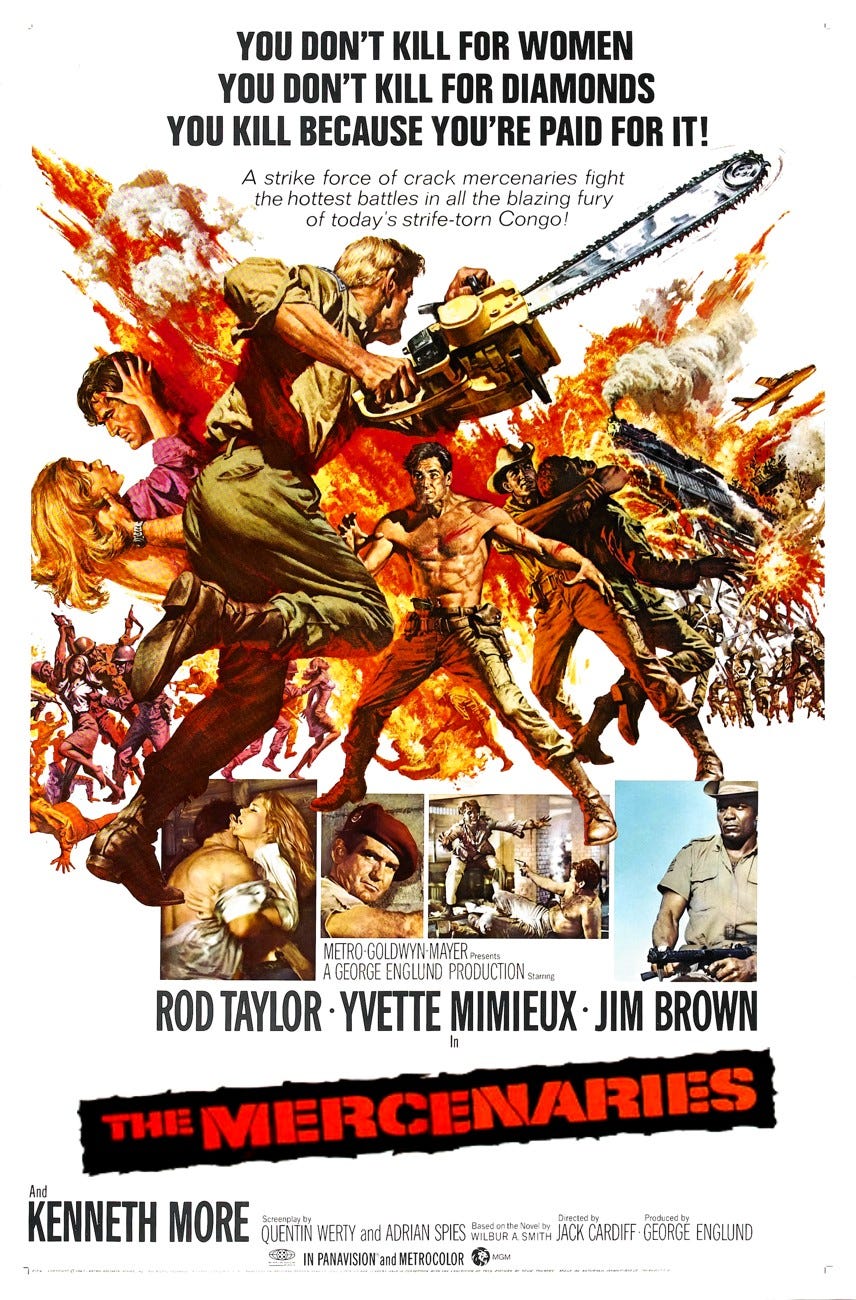
Dark of the Sun certainly has a lurid pulp sensibility. In common with many films of the late 1960s – The Dirty Dozen, Point Blank and Bonnie and Clyde (1967), and The Wild Bunch (1969) – it’s tough, violent, and doesn’t baulk at doing terrible things to its characters. The best scene, given prominent play on the visceral Frank McCarthy art for the film’s poster below, is the chainsaw fight between Henlein and Curry. But there’s a lot more than that. The mercenaries’ train gets strafed by a plane belonging to its own side. Henlein brutally murders two young Congolese children with the excuse they may be spying for the Simbas. There’s the by turns, surreal and brutally violent sequence involving Curry and Rufo having to go back into Port Reprieve to get the diamonds, and the final, almost animalistic fight between Curry and Henlein.
But what I find most fascinating about the film is how it does all of this while maintaining a sharp political sensibility. Complex racial politics, colonialism and imperialism, and the ethical decisions involved in being a mercenary are all discussed. While Curry is only in it for the money, Ruffo, born in the Congo and educated in the US, is genuinely torn about his role as a soldier of fortune. “To you this is just a big hunk of real estate called the Congo,” he tells Curry about their upcoming mission. “To me this is our Bunker Hill, our storming of the Winter Palace.” At another point in the film, as Curry and Ruffo stand in the aftermath of a Simba attack on a religious mission, the mercenary commander picks up a discarded gun, turns to his friend and says: “The gun’s Chinese, Ruffo. Paid for by Russian Rubles. The steel probably came from a West German factory, built by French Francs. Then it was flown on an African airline, probably subsidised by the United States.”
I have had a long standing interest in how genre film treats controversial political subject matter. Indeed, I co-edited a book about on the subject, called Revolution in 35mm: Political Violence and Resistance in Cinema: From the Arthouse to the Grindhouse, 1960-1990. Looking at some of the Letterboxd reviews for the Dark of the Sun, it struck me - that quite apart from the fact that there are a lot of cultural studies graduates with too much time on their hands - how a lot of people not only don’t get the film’s radical overtones; they refuse to countenance that an genre film like this could also be quite politically sophisticated.
Part of why Dark of the Sun manages to the pulls this balancing act off was no doubt the general tenor of the times. It was made in 1967 and released in 1968, THE highpoint of the radical upsurge that shook much of the western world. But there is also a very distinctive verisimilitude running through it due to - some obvious blurring of fact and fiction aside - the story being largely based on true events. There was a Simba rebellion in 1964-65, following the 1961 assassination of the Congo’s first post-independence leader, Patrice Lumumba. Lumumba was murdered – with the full knowledge of Washington, who branded him a communist subversive – by Belgium mercenaries, working in hand in glove with Joseph Mobutu, a local army officer whose subsequent 32 year rule of the country would be marked by political violence and industrial scale corruption. The Simbas, who had been aligned with Lumumba, where commanded by Cuban officers, one of whom was Argentinian Revolutionary, Ernesto Che Guevara.
The rebellion was brutally put down with the help of foreign mercenaries, led by a British-Irish soldier of fortune called “Mad Mike” Hoare. Hoare was a chartered accountant turned mercenary who became something of a media celebrity during his time fighting in the Congo, the numerous books he wrote and, later, through his involvement in an attempted coup d’etat in the Seychelles, a chain of islands off the east coast of Africa. A Christian and a rabid anti-communist, Hoare’s infamous Five Commando Force, was a collection of mainly white soldiers of fortune with a reputation for looting and not taking prisoners. Hoare not only influenced the Curry depiction but the character of Colonel Allen Faulkner, played by Richard Burton, in The Wild Geese (1978). Hoare also served as a technical advisor on that latter film.
The other character in Dark of the Sun to be based on a real person, was Henlein. He is modelled on a German WWII veteran, Siegfried Muller aka Congo Muller. The Congo was only a small part of Muller’s post war exploits, but the Nazi turned mercenary gained considerable profile in his home country after becoming the subject of a 1966 East German documentary, The Laughing Man: Confessions of a Murderer (which you can find in full on YouTube here).
I will, of course, let you know when the podcast episode I did on this film is live.
Post Traumatic Noir
My latest Letterboxd list deals with films about the domestic blowback of America’s war in Vietnam, Laos and Cambodia. It is a work in progress and any additions that you may have for it would be appreciated. You can find the list here.
Youth Gone Wild! 1950s Juvenile Delinquency
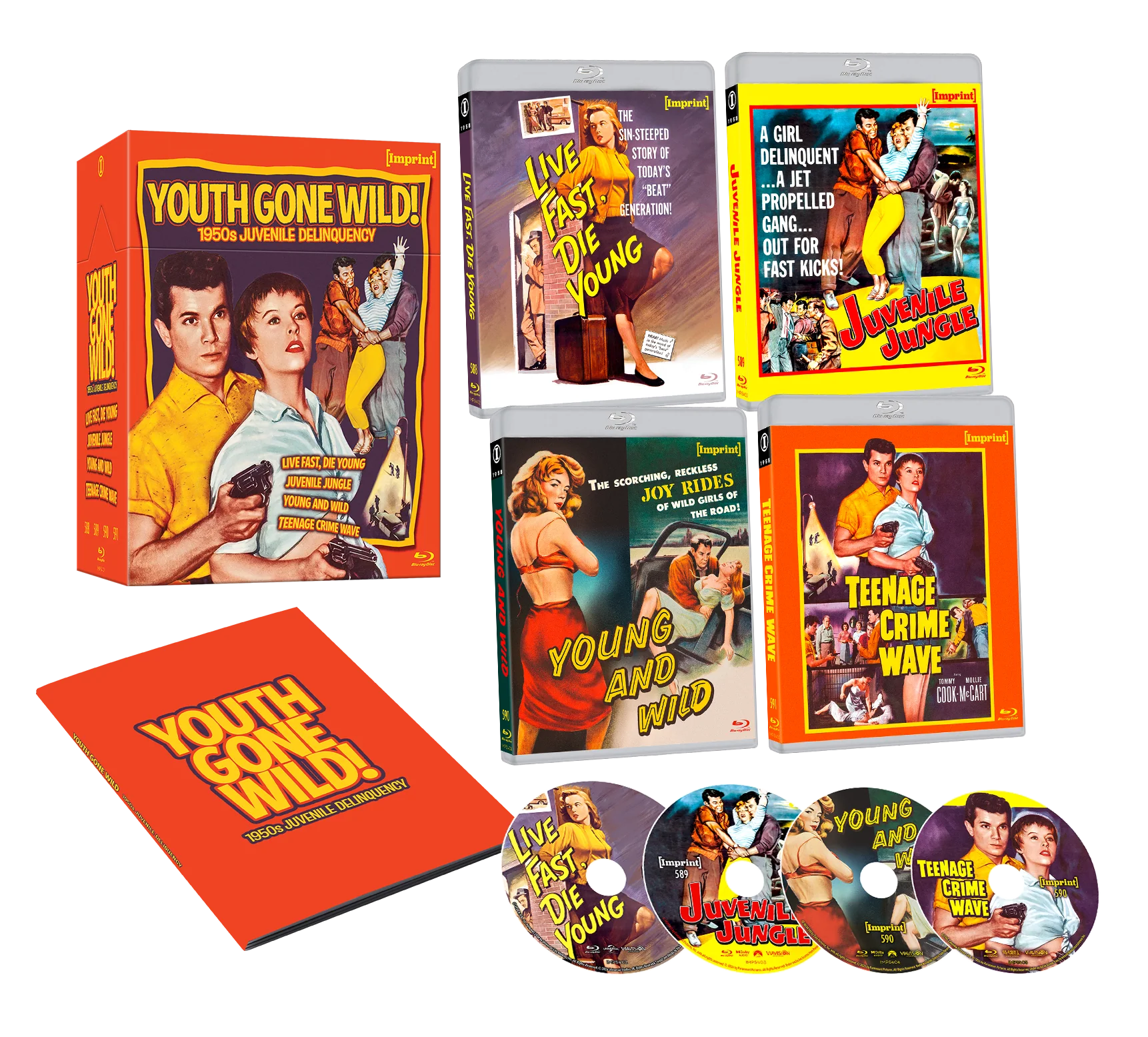
It has been a while between gigs for me, so I am happy yo have an essay included in the extras for this new collection of 1950s juvenile delinquency films, just released by Imprint Films. I contributed a booklet essay on the origins of America’s 1950s juvenile delinquent cinema. It is available for pre-order here.
Until next time.
I really like Letterboxd but your description of some of its users as cultural studies grads with too much time on their hands is spot on. I too was one in early 90s and it took awhile to shake off some of the excess of that strain of my education
I don't know this film, but I will seek it out. Excellent essay. "Guilty Pleasures" wha the hell does that even mean?